Origins of the Swastika Flag
Excerpted from Mein Kampf, Adolf Hitler, 1923:
The organization of our monitor troop clarified a very important question. Up till then the movement had no party insignia and no party flag. The absence of such symbols not only had momentary disadvantages, but was intolerable for the future (...) party comrades lacked any outward sign of their common bond (...) [Hitler then writes about how he attended a mass Marxist demonstration:] a sea of red flags, red scarves, and red flowers (...)
I have, in our movement, always upheld the standpoint that it is a true good fortune for the German nation to have lost the old flag (...) from the bottom of our hearts we should thank Fate for having been gracious enough to preserve the most glorious war flag of all time from being used as a bedsheet for the most shameful prostitution. The present-day Reich, which sells itself and its citizens, must never be permitted to fly the black, white and red flag of honour and heroes...
The question of the new flag —that is, its appearance— occupied us intensely in those days. From all sides came suggestions (...) the new flag had to be equally a symbol of our own struggle, since on the other hand it was expected also to be highly effective as a poster (...) an effective insignia can in hundreds of thousands of cases give the first impetus towards interest in a movement. For this reason we had to reject all suggestions of identifying our movement through a white flag with the old state (...) white is not a stirring colour. It is suitable for chaste virgins' clubs, but not for world-changing movements in a revolutionary epoch. [other assessments of various colours also]
I myself always came out for the retention of the old colours, not only because as a soldier they are to me the holiest thing I know (...) nevertheless, I was obliged to reject without exception the numerous designs which poured in (...) which for the most part had drawn the swastika into the old flag.
I myself, meanwhile, after innumerable attempts, had laid down a final form; a flag with a red background, a white disk, and a black swastika in the middle. After long trials I also found a definite proportion between the size of the flag and the size of the white disk, as well as the shape and thickness of the swastika.
And this remained final.
This is an excerpt taken from Mein Kampff as explained by Adolf Hitler.
Thursday, November 4, 2010
Origins of The Swastika Flag
Wednesday, November 3, 2010
National Socialist German Workers Party
The German Worker's Party used some of this money to advertise their meetings. Adolf Hitler was often the main speaker and it was during this period that he developed the techniques that made him into such a persuasive orator.
Hitler's reputation as an orator grew and it soon became clear that he was the main reason why people were joining the party. This gave Hitler tremendous power within the organization as they knew they could not afford to lose him.
In April, 1920, Hitler advocated that the party should change its name to the National Socialist German Workers Party (NSDAP). Hitler had always been hostile to socialist ideas, especially those that involved racial or sexual equality. However, socialism was a popular political philosophy in Germany after the First World War. This was reflected in the growth in the German Social Democrat Party (SDP), the largest political party in Germany.
Hitler, therefore redefined socialism by placing the word 'National' before it. He claimed he was only in favour of equality for those who had "German blood". Jews and other "aliens" would lose their rights of citizenship, and immigration of non-Germans should be brought to an end.
In February 1920, the NSDAP published its first programme which became known as the "Twenty-Five Points". In the programme the party refused to accept the terms of the Versailles Treaty and called for the reunification of all German people. To reinforce their ideas on nationalism, equal rights were only to be given to German citizens. "Foreigners" and "aliens" would be denied these rights.
To appeal to the working class and socialists, the programme included several measures that would redistribute income and war profits, profit-sharing in large industries, nationalization of trusts, increases in old-age pensions and free education.
On 24th February, 1920, the NSDAP (later nicknamed the Nazi Party) held a mass rally where it announced its new programme. The rally was attended by over 2,000 people, a great improvement on the 25 people who were at Hitler's first party meeting.
Adolf Hitler knew that the growth in the party was mainly due to his skills as an orator and in the autumn of 1921 he challenged Anton Drexler for the leadership of the party. After brief resistance Drexler accepted the inevitable, and Hitler became the new leader of the organization.
Hitler's ability to arouse in his supporters emotions of anger and hate often resulted in their committing acts of violence. In September 1921, Hitler was sent to prison for three months for being part of a mob who beat up a rival politician.
When Hitler was released, he formed his own private army called Sturm Abteilung (Storm Section). The SA (also known as stormtroopers or brownshirts) were instructed to disrupt the meetings of political opponents and to protect Hitler from revenge attacks. Captain Ernst Roehm of the Bavarian Army played an important role in recruiting these men, and Hermann Goering, a former air-force pilot, became their leader.
Hitler's stormtroopers were often former members of the Freikorps (right-wing private armies who flourished during the period that followed the First World War) and had considerable experience in using violence against their rivals.
The SA wore grey jackets, brown shirts (khaki shirts originally intended for soldiers in Africa but purchased in bulk from the German Army by the Nazi Party), swastika armbands, ski-caps, knee-breeches, thick woolen socks and combat boots. Accompanied by bands of musicians and carrying swastika flags, they would parade through the streets of Munich. At the end of the march Hitler would make one of his passionate speeches that encouraged his supporters to carry out acts of violence against Jews and his left-wing political opponents.
As this violence was often directed against Socialists and Communists, the local right-wing Bavarian government did not take action against the Nazi Party. However, the national government in Berlin were concerned and passed a "Law for the Protection of the Republic". Hitler's response was to organize a rally attended by 40,000 people. At the meeting Hitler called for the overthrow of the German government and even suggested that its leaders should be executed.
 Hitler 1889-1936 |  Hitler 1889-1936 |
On 8th November, 1923, the Bavarian government held a meeting of about 3,000 officials. While Gustav von Kahr, the leader of the Bavarian government was making a speech, Adolf Hitler and armed stormtroopers entering the building. Hitler jumped onto a table, fired two shots in the air and told the audience that the Beer Hall Putsch was taking place and the National Revolution had began.
Leaving Hermann Goering and the SA to guard the 3,000 officials, Hitler took Gustav von Kahr, Otto von Lossow, the commander of the Bavarian Army and Hans von Lossow, the commandant of the Bavarian State Police into an adjoining room. Hitler told the men that he was to be the new leader of Germany and offered them posts in his new government. Aware that this would be an act of high treason, the three men were initially reluctant to agree to this offer. Hitler was furious and threatened to shoot them and then commit suicide: "I have three bullets for you, gentlemen, and one for me!" After this the three men agreed.
Soon afterwards Eric Ludendorff arrived. Ludendorff had been leader of the German Army at the end of the First World War. He had therefore found Hitler's claim that the war had not been lost by the army but by Jews, Socialists, Communists and the German government, attractive, and was a strong supporter of the Nazi Party. Ludendorff agreed to become head of the the German Army in Hitler's government.
While Hitler had been appointing government ministers, Ernst Roehm, leading a group of stormtroopers, had seized the War Ministry and Rudolf Hess was arranging the arrest of Jews and left-wing political leaders in Bavaria.
Hitler now planned to march on Berlin and remove the national government. Surprisingly, Hitler had not arranged for the stormtroopers to take control of the radio stations and the telegraph offices. This meant that the national government in Berlin soon heard about Hitler's putsch and gave orders for it to be crushed.
The next day Adolf Hitler, Eric Ludendorff, Hermann Goering and 3,000 armed supporters of the Nazi Party marched through Munich in an attempt to join up with Roehm's forces at the War Ministry. At Odensplatz they found the road blocked by the Munich police. As they refused to stop, the police fired into the ground in front of the marchers. The stormtroopers returned the fire and during the next few minutes 21 people were killed and another hundred were wounded, included Goering.
When the firing started Adolf Hitler threw himself to the ground dislocating his shoulder. Hitler lost his nerve and ran to a nearby car. Although the police were outnumbered, the Nazis followed their leader's example and ran away. Only Eric Ludendorff and his adjutant continued walking towards the police. Later Nazi historians were to claim that the reason Hitler left the scene so quickly was because he had to rush an injured young boy to the local hospital.
After hiding in a friend's house for several days, Hitler was arrested and put on trial for high treason. If found guilty, Hitler faced the death penalty. While in prison Hitler suffered from depression and talked of committing suicide. However, it soon became clear that the Nazi sympathizers in the Bavarian government were going to make sure that Hitler would not be punished severely.
At his trial Hitler was allowed to turn the proceedings into a political rally, and although he was found guilty he only received the minimum sentence of five years. Other members of the Nazi Party also received light sentences and Eric Ludendorff was acquitted.
Hitler was sent to Landsberg Castle in Munich to serve his prison sentence. While there he wrote Four Years of Struggle against Lies, Stupidity, and Cowardice. Hitler's publisher reduced it to My Struggle (Mein Kampf). The book is a mixture of autobiography, political ideas and an explanation of the techniques of propaganda..
In Mein Kampf Hitler outlined his political philosophy. He argued that the German (he wrongly described them as the Aryan race) was superior to all others. "Every manifestation of human culture, every product of art, science and technical skill, which we see before our eyes today, is almost exclusively the product of Aryan creative power.
Tuesday, November 2, 2010
Hitler Becomes Führer

After the Night of the Long Knives, nothing stood between Hitler and absolute power in Germany, except 87-year-old German President Paul von Hindenburg, who now lay close to death at his country estate in East Prussia.
For Hitler, Hindenburg's demise couldn't have come at a better time. He had just broken the back of the rowdy Brownshirts and cemented the support of the Army's General Staff. Now he just needed to resolve the issue of who would succeed Hindenburg as president.
Hitler, of course, decided that he should succeed Hindenburg, but not as president, instead as Führer (supreme leader) of the German people. Although he was already called Führer by members of the Nazi Party and popularly by the German public, Hitler's actual government title at this time was simply Reich Chancellor of Germany.
However, there were still a handful of influential old-time conservatives in Germany who hoped for a return of the monarchy or perhaps some kind of non-Nazi nationalist government after Hindenburg's death. Although they loathed democracy, they also loathed the excesses of the Hitler regime. These were proud men from the 1800s reared in the days of princes and kings and ancient honor codes. And they knew their beloved Fatherland was now in the hands of murderous fanatics such as Himmler and Heydrich who cared nothing about their old-fashioned notions.
Among those conservatives was Franz von Papen, Germany's Vice Chancellor, who was a confidant of President Hindenburg. Just before the Night of the Long Knives, Hindenburg had told him concerning the Nazis: "Papen, things are going badly. See what you can do." But Papen had been unable to do anything except to barely escape with his own life.
Papen, however, had one last trick up his sleeve. Back in April 1934 he almost convinced Hindenburg to declare in his will that Germany should return to a constitutional monarchy upon his death. Hindenburg at first agreed to put it in his will, but then changed his mind and put it in the form of a personal letter to Hitler, to be delivered after his death.
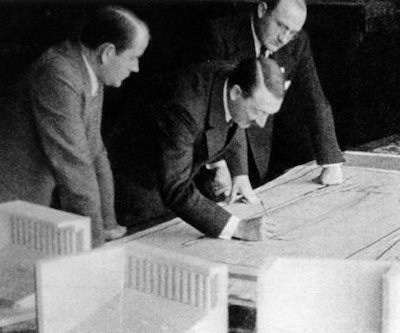
Below: With his position of power now solid - behind the scenes Germany's new F�hrer indulges his passion for architecture - overseeing plans for a redesign of the Nuremberg party rally grounds with young architect Albert Speer (left).
However, for Hitler and his followers, the idea of returning to a monarchy at this point was utterly laughable. Hitler had the Nazi Reichstag (Legislature) completely in his pocket and simply exercised his power to prevent any such thing from happening. He had a law drafted abolishing the office of president and proclaiming himself as Führer.
About 9 a.m. on August 2, 1934, the much anticipated death of President Hindenburg finally occurred. Within hours, the Nazi Reichstag announced the following law, back-dated to August 1st:
The Reich Government has enacted the following law which is hereby promulgated.The law was technically illegal since it violated provisions of the German constitution concerning presidential succession as well as the Enabling Act of 1933 which forbade Hitler from altering the presidency. But that didn't matter much anymore. Nobody raised any objections. Hitler himself was becoming the law.
Section 1. The office of Reich President will be combined with that of Reich Chancellor. The existing authority of the Reich President will consequently be transferred to the Führer and Reich Chancellor, Adolf Hitler. He will select his deputy.
Section 2. This law is effective as of the time of the death of Reich President von Hindenburg.
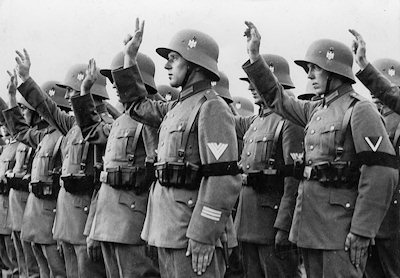
Immediately following the announcement of the new Führer law, the German Officer Corps and every individual soldier in the German Army was made to swear a brand new oath of allegiance:
"I swear by God this sacred oath: I will render unconditional obedience to Adolf Hitler, the Führer of the German Reich and people, Supreme Commander of the Armed Forces, and will be ready as a brave soldier to risk my life at any time for this oath."The unprecedented oath was to Hitler personally, not the German state or constitution, as were previous Army oaths. Obedience to Hitler would now be regarded as a sacred duty by all men in uniform, in accordance with their military code of honor, thus making the German Army the personal instrument of the Führer.
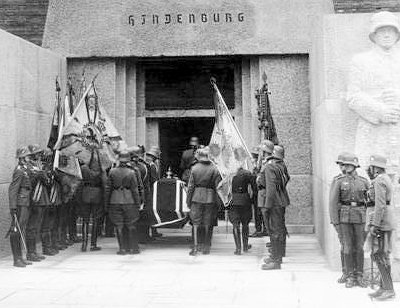
On August 7th, during Hindenburg's elaborate State funeral, General Werner von Blomberg, caught up in the pomp and circumstance of the moment, offered to have the Army officially refer to Hitler as "Mein Führer" instead of the customary "Herr Hitler." Hitler immediately accepted Blomberg's offer.
After the funeral, the Nazis prepared to hold a nationwide vote (plebiscite) giving the German people an opportunity to express their approval of the Führer's new powers and thus legitimize Hitler's position in the eyes of the world.
Meanwhile, Hindenburg's last will and testament surfaced, delivered by Papen to Hitler. Among the documents was the letter from Hindenburg to Hitler suggesting a return of the Kaiser's (Hohenzollern) monarchy. Hitler ignored this message and likely destroyed the letter, as it was not published, and has never been found. The contents were only made known after the war by Papen.
The Nazis did publish Hindenburg's alleged political testament giving an account of his years of service to the Fatherland and containing complimentary references to Hitler. The testament probably was a Nazi forgery and was skillfully used as part of the intensive propaganda campaign to get a big 'Yes' vote for Hitler in the coming plebiscite.
On August 19, about 95 percent of registered voters in Germany went to the polls and gave Hitler 38 million "Ja" votes (90 percent of the vote). Thus Hitler could now claim he was Führer of the German nation with the overwhelming approval of the people.
The next day, August 20, mandatory loyalty oaths for all public officials in Germany were introduced:
"I swear: I shall be loyal and obedient to Adolf Hitler, the Führer of the German Reich and people, respect the laws, and fulfill my official duties conscientiously, so help me God."Hitler, at long last, had achieved total power in Germany.
Two weeks later, during the annual Nazi rally at Nuremberg, the Führer's grand proclamation was read: "The German form of life is definitely determined for the next thousand years. The Age of Nerves of the nineteenth century has found its close with us. There will be no revolution in Germany for the next thousand years."
Before the rally, Hitler had summoned an up-and-coming movie director named Leni Riefenstahl and asked her to film the entire week-long event. Her film of the 1934 Nuremberg rally bore the title personally chosen by Hitler, "Triumph of the Will," and became one of the most powerful propaganda statements ever made.
Germans with God

Hitler ordered race theorists to remove all Jewish words, such as Hallelujah and Jehovah, and all sentiments of compassion.
The 10 Commandments were rewritten and two more added. "Thou shalt not kill
 This is a disambiguation page: a list of articles associated with the same title. " and "Thou shalt shalt
 aux.v. Archaic
A second person singular present tense of shall. not steal" are scrapped.
Thousands of churches received copies in 1941. Most were destroyed by Christians. The only surviving copy was found in a dusty archive in Hamburg.
Hitler's commandments were:
1. Honour God and believe in him wholeheartedly whole·heart·ed
adj.
Marked by unconditional commitment, unstinting devotion, or unreserved enthusiasm: wholehearted approval.
whole .
2. Seek out the peace of God.
3. Avoid all hypocrisy.
4. Holy is your health and life.
5. Holy is your wellbeing and honour.
6. Holy is your truth and fidelity 7. Honour your father and mother - your children are your aid and your example.
8. Keep the blood pure and your honour holy.
9. Maintain and multiply the heritage of your forefathers forefathers npl → antepasados mpl
forefathers npl → ancêtres mpl
forefathers npl → Vorfahren .
10. Be ready to help and forgive.
11. Honour your Fhrer and master.
12. Joyously serve the people with work and sacrifice.


| | |||||||||||||||||||||||||||||||||||||
|
| ||||||||||||||||||||||||||||||||||||
 |  | ||||||||||||||||||||||||||||||||||||
Subscribe to:
Posts (Atom)


 Posts
Posts

